Do women and men really differ in how they behave at work and in relationships? Instead of relying on stereotypes, we turned to our own data — over 12,000 MaxieDISC® results. The findings are both clear and surprisingly balanced.
The DISC model in brief
The DISC model describes behavior across four dimensions:
- Dominant style (D): goal focus, decisiveness, pace, competitiveness.
- Inspiring style (I): sociability, enthusiasm, relationship-building, communication.
- Stable style (S): stability, patience, loyalty, teamwork.
- Conscientious style (C): accuracy, analysis, quality, following the rules.
We all have all four dimensions at different intensities — it is their configuration that creates an individual style.
How we ran the analysis
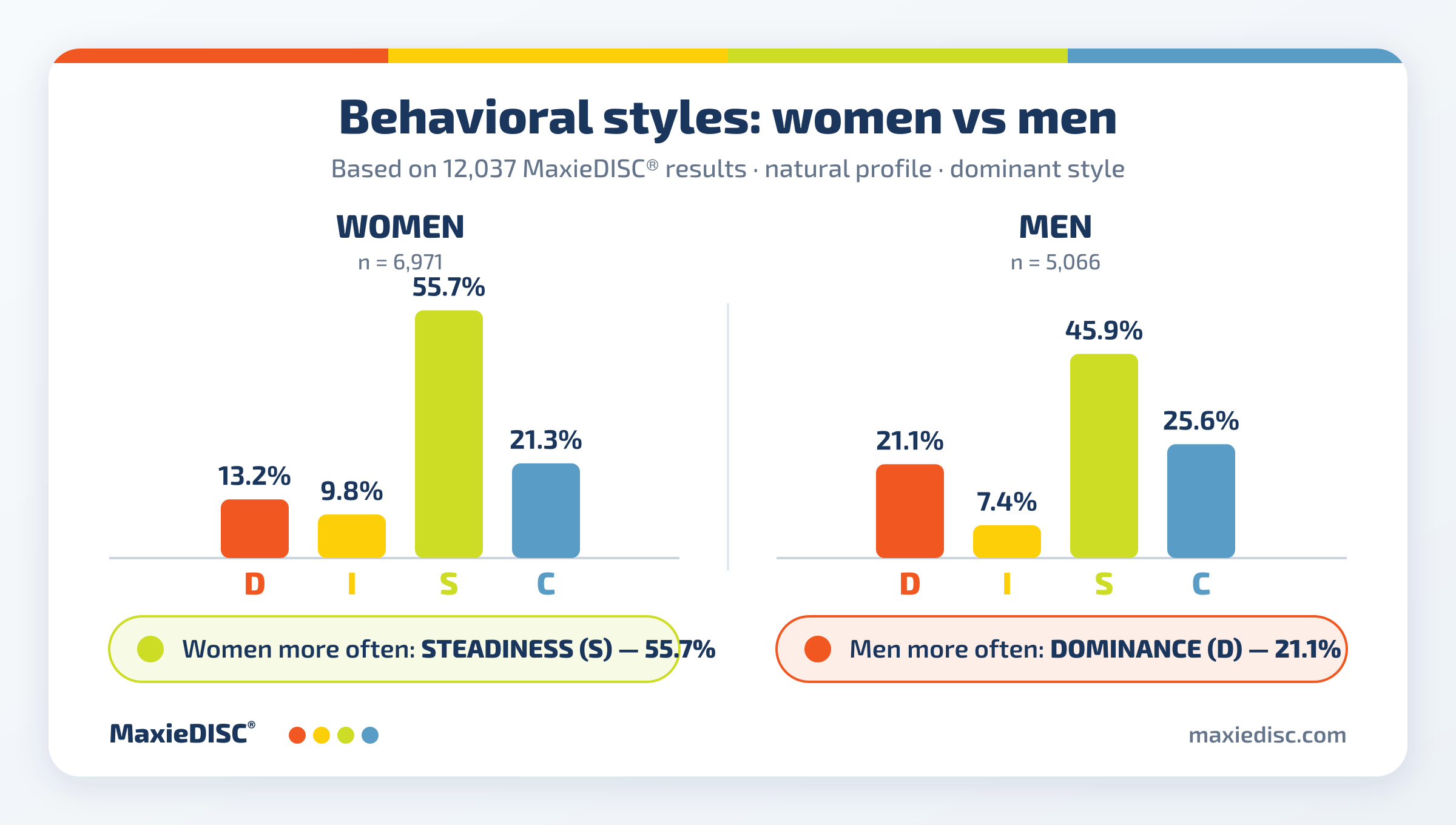
We analyzed 12,037 results of the MaxieDISC® test (6,971 women and 5,066 men) — specifically the natural profile, i.e. behavior „without a mask”, closest to innate preferences. Incomplete and methodologically invalid results were excluded. This is one of the larger analyses of its kind on a Polish sample.
Important caveat: we are talking about average differences between groups, not about the traits of individuals. Respondents took the test in development and recruitment contexts (not a random sample of the whole population). Gender differences exist, but the overlap is huge — there are many women with a strong Dominant style and many calm, steady men.
The results in numbers
| Measure (natural profile) | Women (n=6971) | Men (n=5066) |
|---|---|---|
| Mean D (Dominant style) | 0.05 | 0.19 |
| Mean I (Inspiring style) | −0.11 | −0.17 |
| Mean S (Stable style) | 0.65 | 0.55 |
| Mean C (Conscientious style) | 0.43 | 0.44 |
| Leading style D | 13.2% | 21.1% |
| Leading style S | 55.7% | 45.9% |
| High D (>0.25) | 36.8% | 50.2% |
| High S (>0.25) | 84.7% | 75.9% |
The biggest difference: men and the Dominant style (D)
This is where the data is clearest. Over half of men (50.2%) score high on the Dominant style, compared with 36.8% of women. The Dominant style was the leading one for 21.1% of men and only 13.2% of women — men are therefore about 1.6× more likely to be „D-dominant”. In practice this means, on average, a greater tendency to decide quickly, take the initiative and work in task mode.
Women and the Stable style (S) — the foundation of relationships and teams
The opposite pole is the Stable style. It was the most common leading style for 55.7% of women (vs 45.9% of men), and high S was recorded for as many as 84.7% of women (men: 75.9%). This translates, on average, into greater patience, loyalty, a cooperative mindset and stable, secure relationships. Worth noting: the Stable style is the leading one for both genders — it’s simply even more common among women.
The Inspiring style (I) and Conscientious style (C) — here the differences are small
Perhaps the most interesting finding for those who dislike stereotypes:
- Inspiring style (I): contrary to the popular belief that „women are more sociable”, the gap is small — a high Inspiring style appears in 23.3% of women and 19.5% of men. For both genders it is the least frequently leading dimension.
- Conscientious style (C): virtually no difference — a high Conscientious style appears in 66.7% of women and 67.3% of men. Care for quality and accuracy is distributed almost identically.
What these differences mean in practice
- In communication: on average men get to the point faster (D), women more often protect the relationship and the pace of the conversation (S). Being aware of this shortens the path to understanding.
- In teams: women’s stronger Stable style is a natural team „stabilizer”; men’s high Dominant style drives decisions. A well-balanced team needs both.
- In management and development: it is not about „who is better”, but about matching tasks and communication style to a specific person’s profile — not to their gender.
The key takeaway: these are average differences, not verdicts
MaxieDISC® data shows real, measurable tendencies — but group-level ones. Your individual profile may be completely different from what is „typical” for your gender, and that is perfectly normal. That is why, in development, we always work on a specific result, never on a stereotype.
Frequently asked questions (FAQ)
Do women and men differ in personality according to DISC?
Yes, but moderately. In MaxieDISC® data, men more often have a high Dominant style (D), and women a high Stable style (S). The Inspiring style (I) and Conscientious style (C) are very similar for both genders.
Which DISC style is the most common among Poles?
In our sample, the Stable style (S) dominates for both genders — women 55.7%, men 45.9%.
Does the DISC test measure gender?
No. DISC describes behavioral style, not gender. Differences between groups are statistics, not a rule for an individual.
How can I discover my DISC style?
By taking the MaxieDISC® test — you will receive an individual report with your natural and adapted profile plus development guidance.
Want to discover your own behavioral style — regardless of the statistics? Take the MaxieDISC® test and get a personalized report reviewed by a certified consultant.